

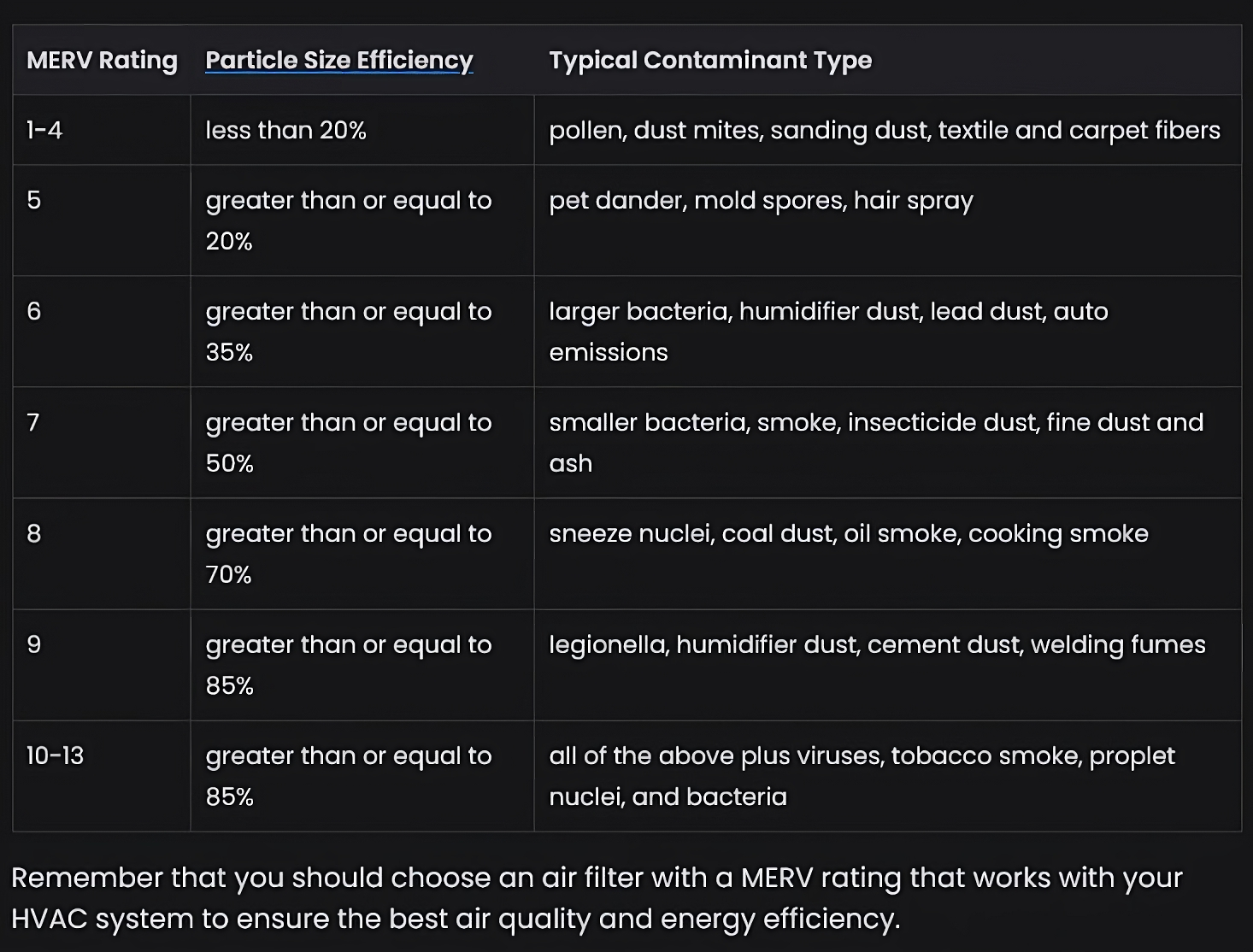
MERV stands for Minimum Efficiency Reporting Value, which is a measurement scale designed by the American Society of Heating, Refrigerating and Air-Conditioning Engineers (ASHRAE) to report the effectiveness of air filters in more detail than other ratings.
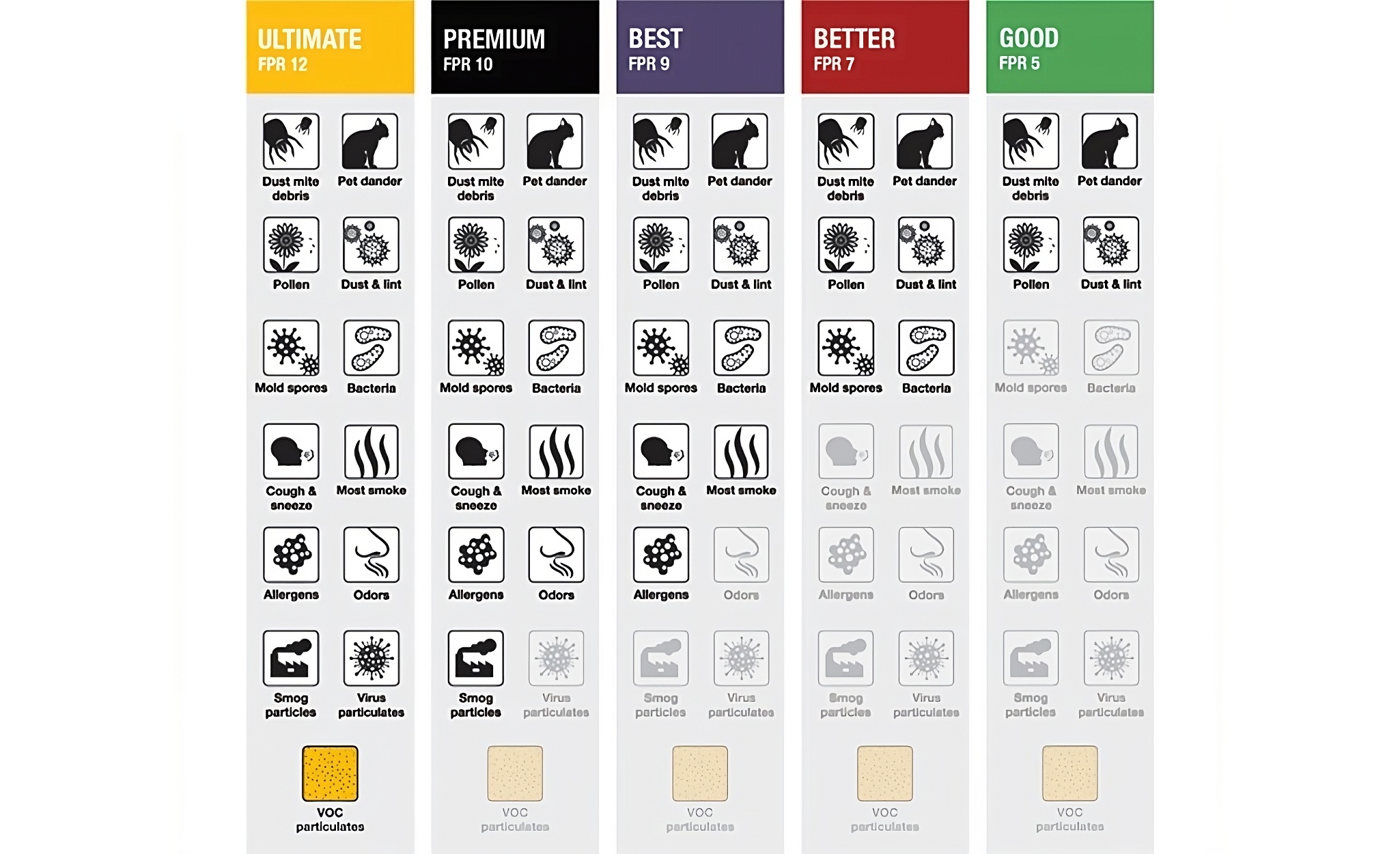
The FPR system, or Filter Performance Rating, is a proprietary rating system created by The Home Depot to rank filters by measuring their ability to capture particulate matter in the air. This system features a number scale from 4 to 10, and a colour-coding system is used to rate the filter’s quality and ability to trap certain particles. The FPR rating has no bearing on the overall efficacy of the air filter itself and is not as thorough as the MERV rating system. The industry standard is to use the MERV rating system, which reports a filter’s ability to capture larger particles between 0.3 and 10 microns.
The Microparticle Performance Rating (MPR) is an air filter rating system that was developed by 3M to measure an air filter’s ability to filter out microparticles. The MPR rating system ranges from 100 to 2800, and higher-rated MPR filters are more efficient at filtering out small particles. The MPR system is different from the MERV rating system because it focuses on a filter’s ability to filter out microparticles. Most MPR-rated filters capture more microparticles than the equivalent MERV-rated filter. However, it is important to note that a higher-rated MPR filter does not necessarily mean that it is the best choice for your home’s HVAC system, as the more efficient a filter is, the more expensive it will be.
- The MERV rating system is the primary rating system used for air filtration and was developed by the American Society of Heating, Refrigerating and Air-Conditioning Engineers (ASHRAE)
- The MERV rating lets you know what air particle size an air filter will trap, and a higher rating means that the filter will trap smaller particles
- The MERV scale ranges from 1 to 20, with higher values corresponding to a greater percentage of particles captured on each pass
- Higher-rated MERV filters can remove more harmful contaminants from the air but can also restrict airflow and cause your HVAC system to work harder, leading to increased energy costs and potential equipment failure
- For most homes, a MERV rating between 8 and 13 is ideal
- The FPR rating system is a proprietary rating system created by The Home Depot to rank filters by measuring their ability to capture particulate matter in the air
- The FPR rating system features a number scale from 4 to 10, and a color-coding system is used to rate the filter’s quality and ability to trap certain particles
- While the FPR rating has no bearing on the overall efficacy of the air filter itself, it can be helpful in comparing the performance of different filters
- The MPR rating system was developed by 3M to measure an air filter’s ability to filter out microparticles
- The MPR rating system ranges from 100 to 2800, and higher-rated MPR filters are more efficient at filtering out small particles
- Most MPR-rated filters capture more microparticles than the equivalent MERV-rated filter
- A higher-rated MPR filter does not necessarily mean that it is the best choice for your home’s HVAC system, as the more efficient a filter is, the more expensive it will be
- MERV filters capture particles that range in size from 0.3 to 10 microns
- MERV filters are rated on a scale from MERV-0 to MERV-16, with higher values indicating better filtration efficiency
- MERV filters are commonly used in residential, commercial, and industrial settings
- MERV filters are less expensive than HEPA filters and can be used in a wider variety of settings
- HEPA filters are designed to capture very small particles, ranging in size from 0.06 to 0.12 microns
- HEPA filters are not MERV-rated because they exceed the ASHRAE Standard rating system used to determine MERV ratings
- HEPA filters are rated based on their ability to capture particles of various sizes, with a true HEPA filter having a rating of 17-20
- HEPA filters are commonly used in hospitals, clean rooms, and other medical settings where high air quality is essential
In summary, HEPA filters are more efficient at capturing small particles than MERV filters, but they are more expensive and are typically used in specialized settings. MERV filters are less expensive and can be used in a wider variety of settings, but they are not as effective at capturing small particles as HEPA filter.